CUDA VMM and GPU Communication Layers
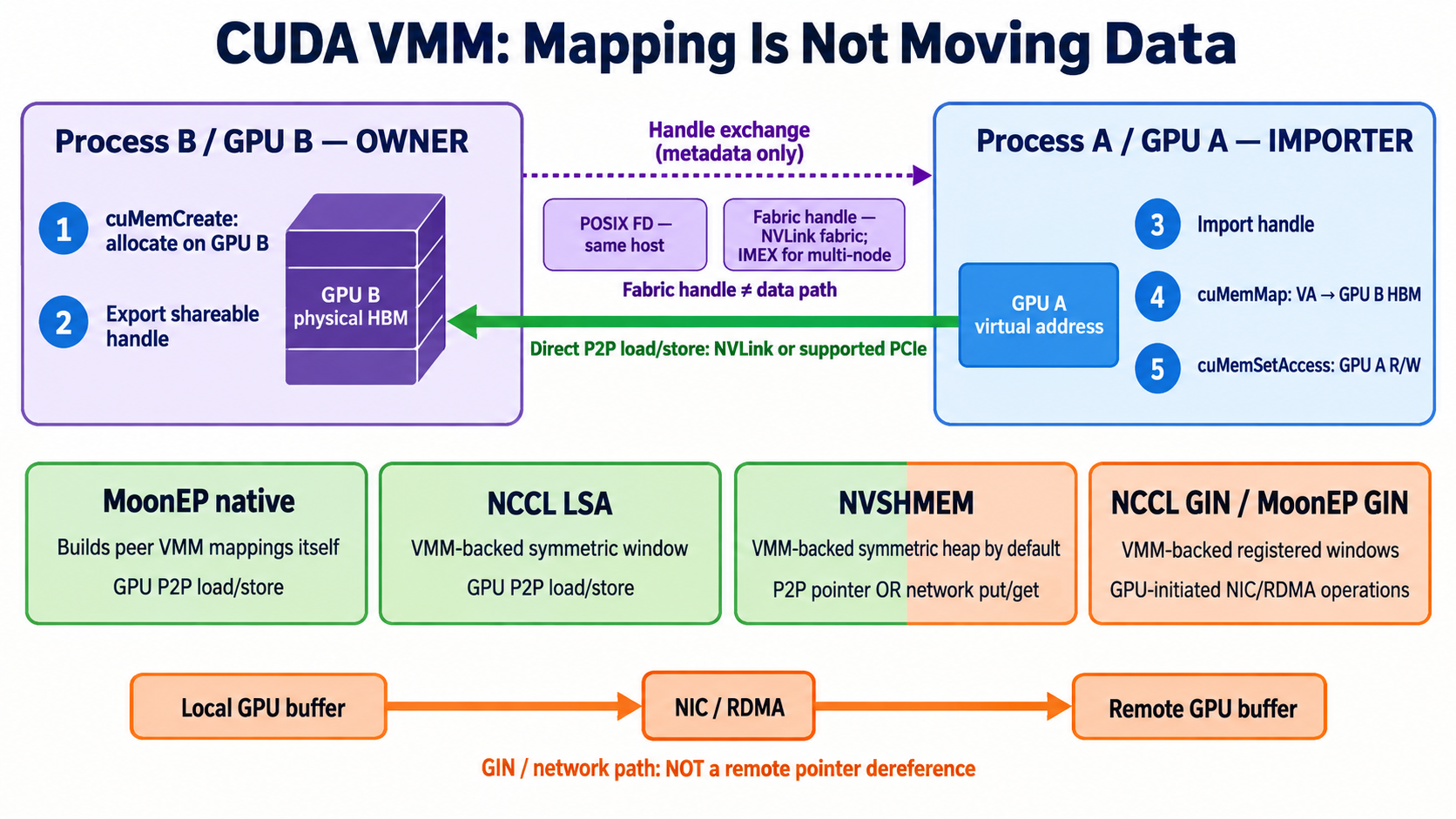
CUDA virtual memory management (VMM) maps a GPU virtual address to a physical allocation; mapping alone does not transfer data. The owner creates GPU memory with cuMemCreate and exports a shareable handle. Another process receives the handle, imports it, calls cuMemMap, and grants its GPU access with cuMemSetAccess. Its kernel can then load or store through that address when a supported P2P path exists.
A POSIX FD shares the allocation between processes on one host. A fabric handle can also be exchanged across nodes in the same NVLink fabric, with IMEX configured. Neither handle is the data path: direct accesses travel over NVLink/NVSwitch or supported PCIe P2P.
The software layers use this foundation differently:
- MoonEP native builds the VMM peer mappings itself and accesses remote memory from its kernels.
- NCCL LSA exposes peer load/store pointers through VMM-backed symmetric windows.
- NVSHMEM uses CUDA VMM for its dynamic symmetric heap by default; communication may use a P2P pointer or a network transport.
- NCCL GIN / MoonEP GIN use registered, VMM-backed windows, but move remote data through GPU-initiated network operations rather than dereferencing a remote GPU pointer.
References: CUDA VMM, NCCL Device API, NVSHMEM memory management.