DeepSeek Sparse Attention Forward and Backward: Formula Derivation and Tensor Shapes
This note derives the forward and backward equations used by the shared-KV, top-k sparse attention operator discussed in the TileLang and cuDNN DSA implementations. Every symbol is annotated with its shape, first for one query token and one query head, and then in the matrix form used by a 64-head CTA.
The concrete configuration used throughout the implementation discussion is:
| Symbol | Meaning | Concrete value |
|---|---|---|
H |
Number of query heads | 64 |
T |
Selected KV rows per query token, or top-k | 2,048 |
Dqk |
Query/key width | 576 |
Dv |
Value/output width | 512 |
BK |
KV rows processed by one inner-loop tile | 64 |
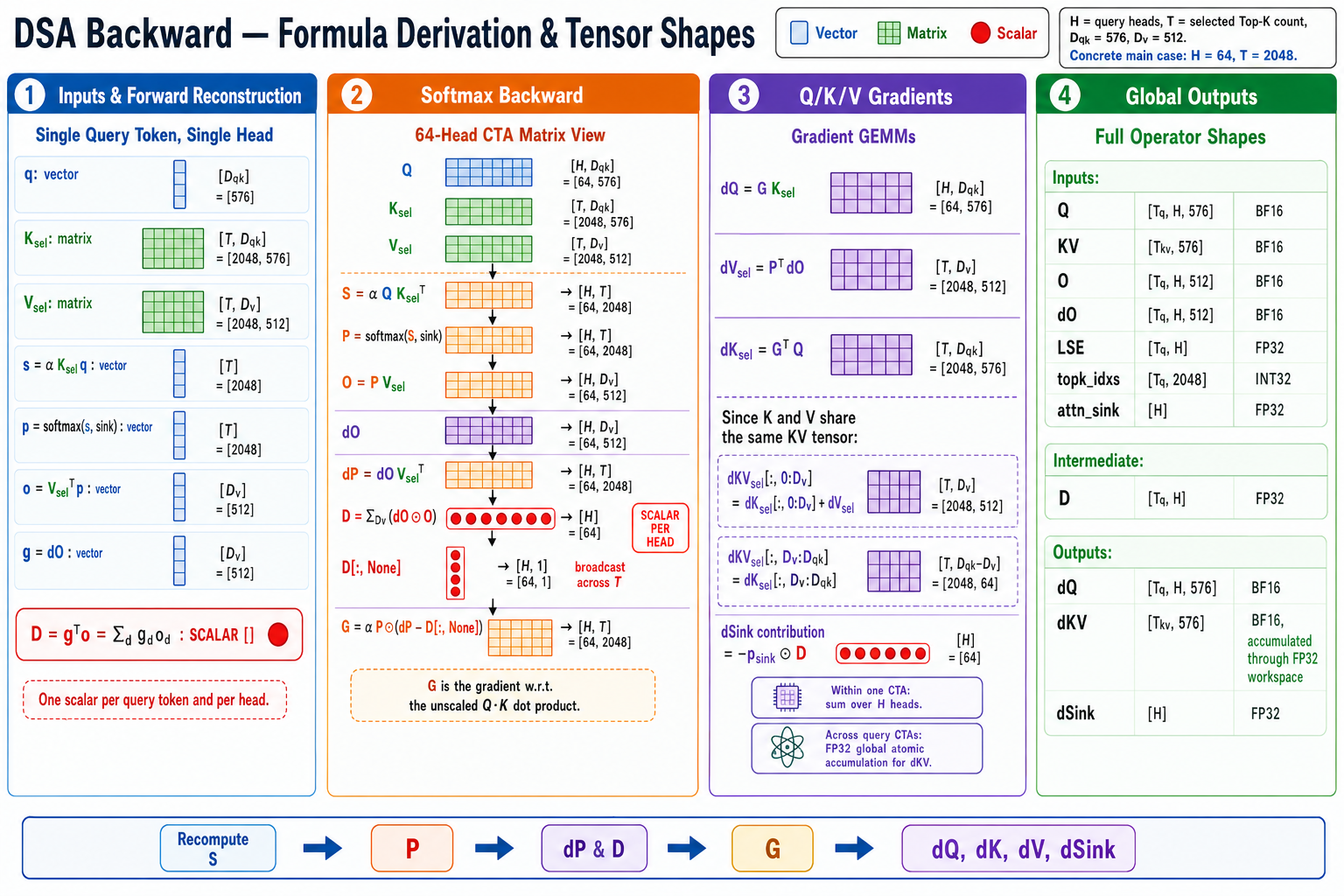
1. Operator-level inputs and outputs
Let Tq be the total number of packed query tokens and Tkv the total number
of packed KV tokens. A representative shared-KV DSA interface has the following
logical tensors:
| Tensor | Shape | Typical storage type | Role |
|---|---|---|---|
Q |
[Tq, H, Dqk] |
BF16 or FP16 | Query vectors |
KV |
[Tkv, Dqk] |
BF16 or FP16 | Shared key/value rows |
topk_idxs |
[Tq, T] |
INT32 | Selected global KV row indices for each query token |
topk_length |
[Tq] |
INT32 | Optional valid selection count when rows are padded |
attn_sink |
[H] |
FP32 | Optional learned sink logit, one scalar per query head |
O |
[Tq, H, Dv] |
BF16 or FP16 | Saved forward output |
LSE |
[Tq, H] |
FP32 | Saved log-sum-exp normalizer |
dO |
[Tq, H, Dv] |
BF16 or FP16 | Upstream gradient |
The backward operator produces:
| Tensor | Shape | Typical storage type | Role |
|---|---|---|---|
dQ |
[Tq, H, Dqk] |
BF16 or FP16 | Query gradient |
dKV |
[Tkv, Dqk] |
BF16 or FP16 | Gradient of the tied KV tensor |
dSink |
[H] |
FP32 | Optional attention-sink gradient |
For the tied KV layout, the full 576-wide row acts as the key, while its
first 512 components also act as the value:
Consequently, the first 512 components of dKV receive both key-gradient and
value-gradient contributions. The final 64 components receive only the key
gradient.
topk_idxs is shared by all H query heads belonging to the same query token.
It identifies individual KV tokens, not entire sequences. In a packed THD
layout, those indices may already be global packed-row indices, so the sparse
attention core does not inherently need cu_seqlens; sequence boundaries must
already have been respected when the index list was constructed.
2. One query token and one head
Fix one query token i and one query head h. To keep the matrix orientation
unambiguous, vectors in this section are column vectors.
| Symbol | Shape | Meaning |
|---|---|---|
q |
[Dqk] |
Query vector Q[i, h, :] |
I |
[T] |
Selected indices topk_idxs[i, :] |
Ksel |
[T, Dqk] |
Selected key rows K[I, :] |
Vsel |
[T, Dv] |
Selected value rows V[I, :] |
s |
[T] |
Scaled attention logits |
p |
[T] |
Probabilities assigned to selected KV rows |
p_sink |
scalar | Probability assigned to the optional sink |
o |
[Dv] |
Forward output vector |
g |
[Dv] |
Upstream gradient dO[i, h, :] |
D |
scalar | Dot product of g and o |
2.1 Forward scores
Let alpha be the attention scale, normally related to the inverse square root
of the query/key width. The selected KV scores are:
Equivalently, one selected row produces one scalar:
2.2 Softmax with an optional attention sink
Let z be the scalar sink logit for head h. The denominator includes both
the selected KV logits and the sink:
The probabilities are:
Therefore:
The sink has no value vector in this formulation. It absorbs probability mass but contributes a zero vector to the output. The forward output is therefore:
If attention sink is disabled, take z to negative infinity. Then p_sink is
zero and the equations reduce to ordinary softmax over the selected KV rows.
3. Backward derivation, one step at a time
Assume the scalar loss is L, and let:
3.1 Gradient with respect to each probability
Because the output is a weighted sum of value vectors, changing one scalar
probability p_t changes o in the direction of v_t:
Applying the chain rule gives one scalar per selected KV row:
Stacking all rows gives:
3.2 Why D = dO dot O is a scalar
Both g, which is dO for this token and head, and o are vectors of length
Dv. Their dot product reduces the value-feature dimension:
Using the forward equation, this scalar can also be written as:
Thus, D is scalar for one query token and one head. Across the full operator,
there is one such scalar per token-head pair, so the full D tensor has shape
[Tq, H].
3.3 Gradient through softmax
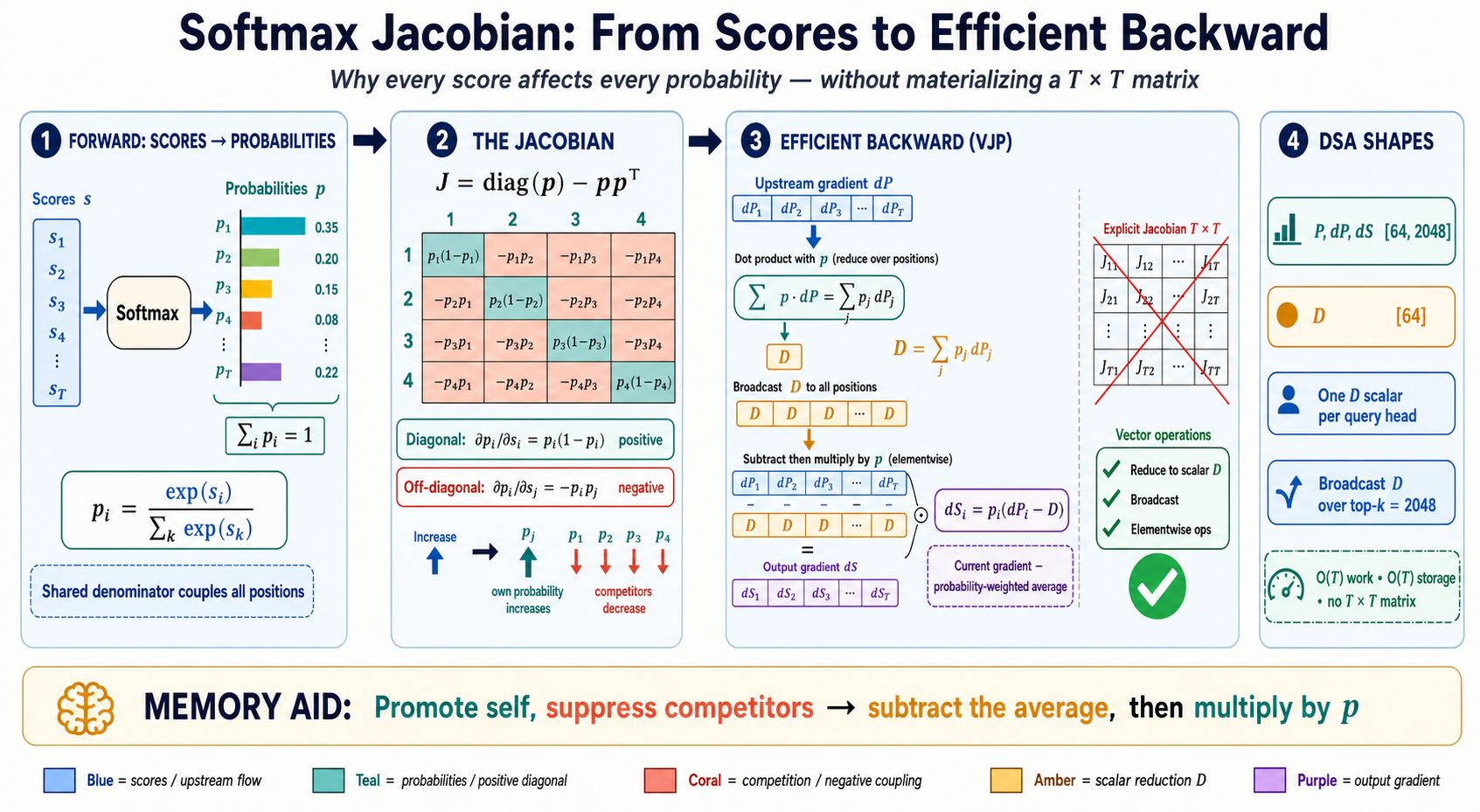
The softmax Jacobian for a selected score is:
Applying the chain rule and collecting terms:
Define the gradient of the scaled score as dS:
The same scalar D is broadcast across all T selected positions. Many GPU
kernels instead define G as the gradient with respect to the unscaled dot
product, folding the scale into this stage:
3.4 Query, key, and value gradients
The query gradient is a weighted sum of selected key rows:
The selected key gradient is an outer product:
The selected value gradient is also an outer product:
For the tied KV row layout, these contributions merge as follows:
The same KV row can be selected by many query tokens, so all of those
contributions must be reduced into the corresponding global dKV row.
3.5 Attention-sink gradient
The sink contributes zero to o, so its probability-gradient is zero. Its
logit-gradient still receives the negative softmax coupling term:
The final dSink[h] is the sum of this scalar over all query tokens belonging
to head h.
4. A tiny numerical example
Use a one-dimensional value space with two selected KV rows and one sink:
The output and the scalar reduction are:
The probability-gradients are dP_1 = 2 and dP_2 = -1. Therefore:
The three logit-gradients sum to zero, as required by softmax shift invariance:
This example makes the role of D concrete: it is the common scalar correction
subtracted from every selected probability-gradient before multiplication by
that position's probability.
5. Matrix form for one query token and all 64 heads
The GPU kernel can process all heads for one query token together. For a fixed
query token i, use the following matrices:
| Tensor | Concrete shape | Meaning |
|---|---|---|
Qi |
[64, 576] |
Queries for all heads |
Ksel |
[2048, 576] |
Selected keys shared by all heads |
Vsel |
[2048, 512] |
Selected values shared by all heads |
S, P, dP, G |
[64, 2048] |
Per-head, per-selected-row intermediates |
Oi, dOi |
[64, 512] |
Output and upstream gradient |
D |
[64] |
One reduction scalar per head |
dQi |
[64, 576] |
Query gradient |
dKsel |
[2048, 576] |
Key-gradient contribution from this query token |
dVsel |
[2048, 512] |
Value-gradient contribution from this query token |
The forward equations become:
The backward equations become:
This matrix view exposes the four major matrix multiplications in backward:
dP, dQ, dK, and dV.
6. Tiled GPU execution and intermediate shapes
With T = 2048 and BK = 64, one query CTA walks over 32 selected-KV tiles:
For one 64-row KV tile, the important logical shapes are:
| Tile | Shape | Typical role |
|---|---|---|
Q |
[64, 576] |
Reused across all 32 KV tiles |
dO |
[64, 512] |
Reused across all 32 KV tiles |
Ktile |
[64, 576] |
Gathered selected key rows |
Vtile |
[64, 512] |
Prefix of Ktile in the tied layout |
Stile |
[64, 64] |
Score fragment |
Ptile |
[64, 64] |
Recomputed probability fragment |
dPtile |
[64, 64] |
Probability-gradient fragment |
Gtile |
[64, 64] |
Scaled score-gradient fragment |
dQ contribution |
[64, 576] |
Accumulated over the 32 tiles |
dKV tile |
[64, 576] |
Reduced across 64 heads, then scattered |
A high-level pipeline is:
- Load or gather
Ktileand its 512-wide value prefix into shared memory. - Compute
Stile = alpha * Q * Ktile transposewith tensor-core MMA. - Reconstruct
PtilefromStileand the saved normalization state. - Compute
dPtile = dO * Vtile transpose. - Form
Gtile = alpha * Ptile * (dPtile - D[:, None])elementwise. - Accumulate
dQ += Gtile * Ktile. - Compute
dKtile = Gtile transpose * QanddVtile = Ptile transpose * dO. - Merge
dKtileanddVtileinto the tied 576-widedKVcontribution. - Scatter-add the contribution to the global FP32
dKVaccumulation buffer.
The exact physical ownership of fragments between registers, shared memory, and tensor memory depends on the kernel and architecture. The shapes above are logical matrix shapes; a warpgroup MMA instruction stores only distributed fragments of them in each thread or in tensor memory.
7. Saved LSE conventions and probability reconstruction
Saving the full probability tensor would require [Tq, H, T] elements. At
top-k 2,048 this is much larger than saving one FP32 normalizer per token and
head. Backward therefore normally recomputes scores and reconstructs
probabilities from the saved LSE.
Two LSE conventions must be distinguished.
7.1 Sink-inclusive LSE
If forward saves the complete natural-log denominator:
then:
7.2 KV-only LSE
Some forward interfaces, including a FlashMLA-style sparse forward contract, may return an LSE over selected KV logits only:
When a sink is enabled, backward first combines it with the sink logit:
The rest of backward must use LSE_total. Confusing KV-only and sink-inclusive
LSE changes every reconstructed probability and is therefore a correctness
error, not merely a performance detail.
7.3 Base-2 implementation form
GPU exponential instructions often use base 2. A preprocessing kernel can store:
Then the main kernel reconstructs probabilities and the centered derivative as:
The signs may look unusual, but this representation removes two subtractions from the hot loop while preserving the same mathematical result.
8. End-to-end forward and backward data flow
Forward
Q,KV, andtopk_idxsselect and scoreTKV rows per query token.- The per-head sink logit is optionally included in the softmax denominator.
- The selected values are reduced into
O [Tq, H, Dv]. - Forward saves
LSE [Tq, H], either KV-only or sink-inclusive according to the interface contract.
Backward prepass
- Read
O [Tq, H, Dv]anddO [Tq, H, Dv]. - Reduce the
Dvdimension to computeD [Tq, H]. - Normalize the LSE convention and optionally prepare
scaled_LSE [Tq, H].
Main sparse backward
- Gather selected KV tiles using
topk_idxs [Tq, T]. - Recompute scores and probabilities instead of loading a saved probability tensor.
- Compute
dP,G, and the matrix products fordQ,dK, anddV. - Write one private
dQresult for the current query token. - Merge tied key/value gradients and atomically accumulate them into an FP32
global
dKVworkspace because different query CTAs can update the same KV rows. - Accumulate
dSink [H]if sink training is enabled.
Finalization
- Convert the FP32
dKVworkspace to the requested BF16 or FP16 output type. - Return
dQ,dKV, and optionallydSink.
9. Precision and determinism
A performance-oriented implementation can preserve the intended numerical contract with the following policy:
| Stage | Recommended accumulation or compute type |
|---|---|
Input Q, KV, O, dO |
BF16 or FP16 storage |
Score and dP MMA accumulation |
FP32 |
LSE, exponentials, D, and sink arithmetic |
FP32 |
| Probability and score-gradient operands fed to MMA | BF16 or FP16 as required by the MMA path |
dQ, dK, and dV MMA accumulation |
FP32 |
Cross-CTA dKV workspace and atomic reduction |
FP32 |
Final dQ and dKV output |
Cast to the interface type |
The global FP32 atomic reduction makes dKV mathematically well defined but
not generally bitwise deterministic: the order in which query CTAs reach the
same KV row can change, and FP32 addition is not associative. This can produce
small run-to-run bit differences without changing the formula or storage
precision. A deterministic implementation would need a fixed reduction order,
usually at the cost of extra workspace, an additional reduction pass, or lower
parallelism.
10. Compact shape checklist
For the concrete H = 64, T = 2048, Dqk = 576, Dv = 512 case:
| Quantity | One token, one head | One token, all heads | Whole packed problem |
|---|---|---|---|
| Query | [576] |
[64, 576] |
[Tq, 64, 576] |
| Selected key | [2048, 576] |
Shared [2048, 576] |
Source [Tkv, 576] |
| Selected value | [2048, 512] |
Shared [2048, 512] |
Prefix of source KV |
| Scores/probabilities | [2048] |
[64, 2048] |
Recomputed, not saved |
| Output/upstream gradient | [512] |
[64, 512] |
[Tq, 64, 512] |
D = dO dot O |
scalar | [64] |
[Tq, 64] |
| Query gradient | [576] |
[64, 576] |
[Tq, 64, 576] |
| Selected KV contribution | [2048, 576] |
Reduced [2048, 576] |
Accumulated into [Tkv, 576] |
| Sink gradient | scalar | [64] before token reduction |
[64] after reduction |
The central shape fact is simple: O and dO are vectors for one token-head
pair, so their dot product is a scalar. That scalar becomes [Tq, H] only after
stacking all query tokens and heads, and it is broadcast over the top-k axis
when forming the softmax score gradient.